

Start with fleece for teams that need extra warmth in cool, sheltered spaces. Start with a softshell for people who spend much of the shift moving outdoors in the wind. For employees who move between both settings, try a fleece they can wear indoors and a softshell they can put on outside. Check that the two layers fit comfortably together before ordering.
Look at a typical shift before you choose. A technician who walks between buildings all morning and a colleague who spends most of the day at an indoor bench may both need jackets, but they need them for different reasons. The decision depends on where the cold comes from, how hard people are working, and what they wear underneath.
Choose for the conditions your team works in
Swipe to see the full table.
| Working conditions | What to try first | What to check |
|---|---|---|
| Cool workshop or sheltered stockroom | Fleece over the usual work shirt | Warmth during quieter tasks and comfort while moving |
| Frequent outdoor rounds in the wind | Softshell over the usual work shirt | Wind resistance for the chosen fabric and room to reach |
| Indoor work with regular outdoor calls | Fleece indoors, with a softshell for outdoor work | Shoulder room, cuff bulk and access to pockets with both layers on |
| Regular exposure to sustained rain | Waterproof outer layer with a suitable layer underneath | The agreed rain protection specification for the finished jacket |
Fleece is a practical insulating layer. Its raised surface helps hold warm air, and different constructions give you options for thickness and feel. If a team is comfortable standing still but gets too warm once they start moving, compare a lighter fleece before you add another garment. Some fleece fabrics are designed to resist more wind than standard fleece, so check the construction if wind is part of the brief. Polartec's guide to fleece insulation
A softshell is an outer layer designed to let people move in cool, changeable conditions. Wind resistance and light weather protection depend on the fabric and the jacket construction. Ask what face fabric and backing the supplier proposes, whether it includes a membrane, and what evidence supports any performance requirement you put in the order. For repeated work in steady rain, specify a waterproof outer layer suited to the job. Rab's softshell jacket guide
People on the same site can need different amounts of insulation. A technician walking between buildings may prefer a softshell with a lighter backing, while a colleague spending long stretches at the gate may want room for a fleece underneath. Ask both to try the proposed kit during their usual tasks before you settle on one construction for everyone.
Compare two Tervorin style references
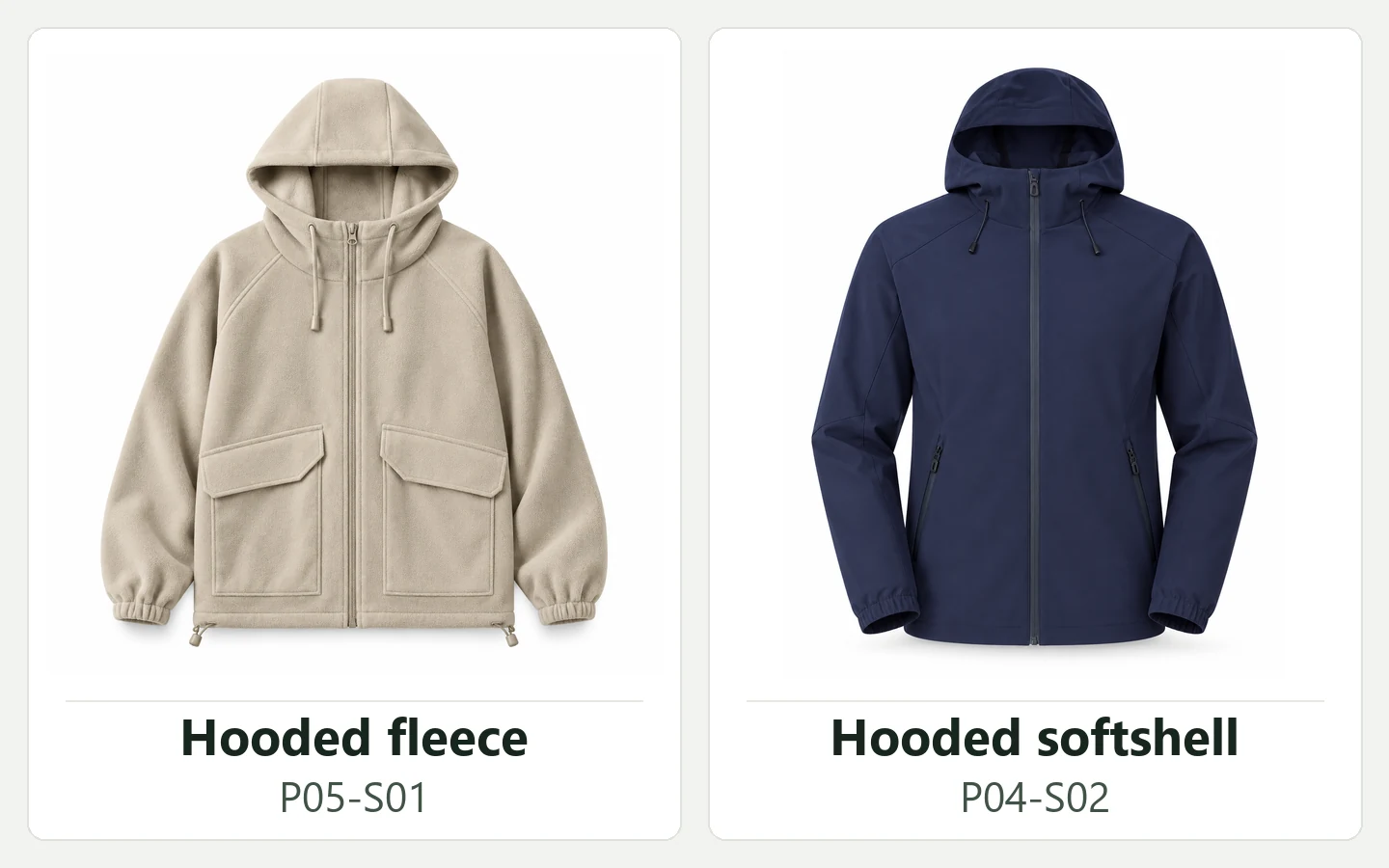
The hooded fleece reference P05-S01 gives you a full zip, two large lower flap pockets, elastic cuffs and a drawcord hem. It's a starting point if staff want a fleece they can wear on its own. If the same fleece will spend most of the day under another jacket, ask whether a collar and a simpler pocket layout would sit more comfortably underneath.
The hooded softshell reference P04-S02 has an adjustable hood, zipped side pockets and partly elastic cuffs. Try the hood and pocket openings with the gloves or usual layers worn on the job. Choose the fabric face and backing separately, then confirm the construction and fit on the sample.
Check both layers with the jacket fastened
Ask employees to try the sample over the shirt or midlayer they actually wear. For a combined kit, compare the softshell over a work shirt and again over the fleece. It should still feel usable on days when the extra insulation stays in the locker.

- Reach forward and up. Check whether the jacket pulls across the shoulders or the cuffs ride up. Use the reach people make at work, such as taking an item from a shelf.
- Bend and sit. See where the hem lands and whether the fleece bunches at the waist. Try the jacket fully zipped for both movements.
- Use the collar, cuffs and pockets. Turn your head with the collar fastened or hood in use. Check that you can work the zippers and reach the pockets with your normal gloves, if worn.
Try more than one size. If several wearers report the same pull across the back, review the cut and the layers before changing the whole size list. Record the underlayers used for the fit check alongside the approved size chart so the next order uses the same assumptions.
If your team needs one jacket, use the condition that causes the most discomfort on a regular shift to choose your first sample. If you expect staff to use both layers, bring them to the fitting together. Include the work areas, usual underlayers and any wind or rain requirements when you request samples.